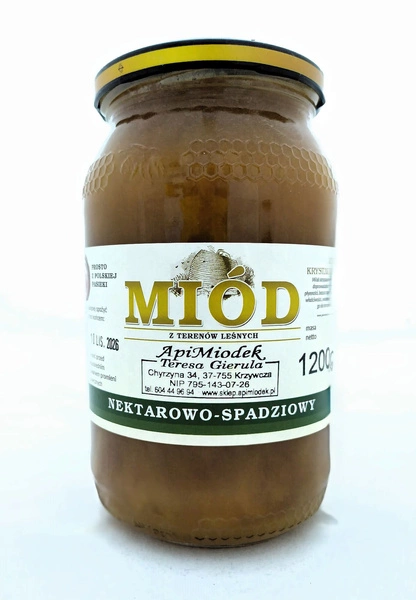
What is nectar and honeydew honey? The taste of a forest blend

Nectar and honeydew honey comes from bees working both flower nectar and honeydew during a harvest. It does not mean that two finished jars were stirred together after bottling. The resulting honey can bring floral sweetness and a deeper woodland note into the same spoonful. The balance changes with place, weather and season.
Two sources in one harvest
Flowers provide nectar. Honeydew is a sweet substance found on plants in connection with sap-feeding insects, and bees may collect it from leaves or needles. When both sources are available in the forage area, a harvest can have a nectar-and-honeydew character. The phrase describes where the bees gathered material, not an exact fifty-fifty recipe.
No responsible beekeeper can promise a fixed proportion from a name alone. The flowering calendar, weather and honeydew flow vary. Even honey from the same apiary can therefore look and taste different across seasons.
How does it differ from honeydew honey?
Honeydew honey is associated with a honeydew-rich forage and often tastes darker, deeper and less plainly floral. In a nectar-and-honeydew honey, the flower element may bring a brighter sweetness. These are tasting tendencies, not a home laboratory test: colour alone cannot measure how much honeydew a jar contains.
“Forest honey” is also a broad descriptive phrase in many markets. Read the full product name and source information before assuming that every woodland honey is identical. A label and the beekeeper's batch information tell you more than a dark tint.
ApiMiodek's Bieszczady forest honey
Our Bieszczady forest honey with nectar and honeydew is a concrete example of this style. The regional wording belongs to that product. It should not be applied automatically to every jar sold by the apiary. Expect a gentler floral sweetness at first and a more layered woodland impression afterwards; the exact intensity is natural to the batch.
- Nose: woodland and floral, sometimes softly herbal or resinous.
- Palate: rounded sweetness with a darker undertone.
- Texture: may be liquid or crystallised, depending on batch and time.
- Finish: lingering, gently woodland rather than simply sweet.
Why the jar changes between seasons
Weather cannot be scheduled around an apiary. A warm spell may favour one source of forage, while rain interrupts another. Flowering plants at a forest edge and honeydew on trees do not provide a predictable harvest every year. The strength of bee colonies and timing of collection matter too.
A different amber shade, aroma or crystallisation rate need not signal a different product or a fault. If the state of the jar matters for a recipe or a gift, check the current product variant and ask about the batch rather than relying on an old photograph.
Pairing and serving ideas
Taste a little at room temperature first. On sourdough bread, the woodland note remains distinct. With cottage cheese or a mild aged cheese, it offers contrast without dominating. It works with ripe pear and walnuts; in porridge, stir it in after cooking. Add it to tea after the drink has cooled slightly if you want to keep more of its aroma.
A small amount also rounds out a dressing for roasted vegetables. Start with less than you think you need: the aim is to balance salt and acidity, not to turn a savoury dish into dessert.
Who might enjoy it?
It is a useful choice for someone curious about woodland flavours but hesitant about a particularly intense, resinous honeydew honey. Compared with a mild multifloral honey, it can offer more depth while retaining a floral entrance. If you prefer a very neutral sweetener for yoghurt, a lighter floral honey may suit you better.
The name is a starting point, not a guarantee of one taste in every jar. Try the batch as food and select it for the dishes you actually make. Honey is still a sugar-rich food; flavour and culinary use are better reasons for choosing it than broad medical claims.
Reading the product information
Look for the producer, country of origin, net weight and specific variety. A regional claim needs to describe the actual product, not merely evoke a landscape. Dark colour and thickness alone do not prove where a jar came from. The product page has the current variant and availability.
Crystallisation is a natural change of texture. It cannot establish the floral or honeydew proportion by itself. If a seller claims a guaranteed cure or a perfectly identical flavour year after year, ask for more concrete product information.
Three ways to explore a first jar
Bread, butter and a pinch of salt
Spread butter on a slice of hearty bread, add a thin layer of honey and finish with a few crystals of salt. This simple combination makes it easier to notice the floral opening and the woodland finish separately. More honey is not necessarily better; a small amount leaves room for the bread's flavour.
Pear, cheese and walnuts
Arrange a ripe pear with a mild cheese and a few walnuts. Add the honey just before serving, a teaspoon at a time. Varying the balance helps you find the pairing you like, without letting the sweetness cover the fruit or the cheese.
Porridge after cooking
Cook oats with apple or pear, let the bowl stand briefly and add honey after cooking. Taste it before adding cinnamon, which can hide delicate woodland notes. If you have two batches, the same plain porridge is a useful way to compare them.
Storage and serving
Keep the lid firmly closed and store the jar in a dry, shaded place away from a stove or sunny window. Use a clean, dry spoon. Honey absorbs moisture and nearby aromas, so close the jar promptly after serving. It does not need to be heated just because it has become thicker.
For tasting, let a cool jar reach room temperature and try a small amount on its own. Temperature changes how strongly we perceive aroma. Crystallisation is natural and does not make the honey a different variety. As with all honey, do not give it to infants under twelve months.
FAQ
What does nectar and honeydew honey mean?
It describes a honey harvest in which bees used flower nectar and honeydew. The name does not establish an exact ratio.
Is it made by mixing two finished honeys?
That is not what this ApiMiodek product name means. It refers to forage collected by the bees.
Is all forest honey honeydew honey?
No. Check the full product description; “forest honey” alone is broad.
What does it taste like?
Often floral sweetness with a deeper woodland note, but the actual batch can vary.
Can it crystallise?
Yes. Its speed and texture depend on the batch and storage.
How should I serve it?
Try it on bread, with cheese, pear or porridge, or in a slightly cooled drink.
Recommended